What does a corporate retreat in Provence cost?
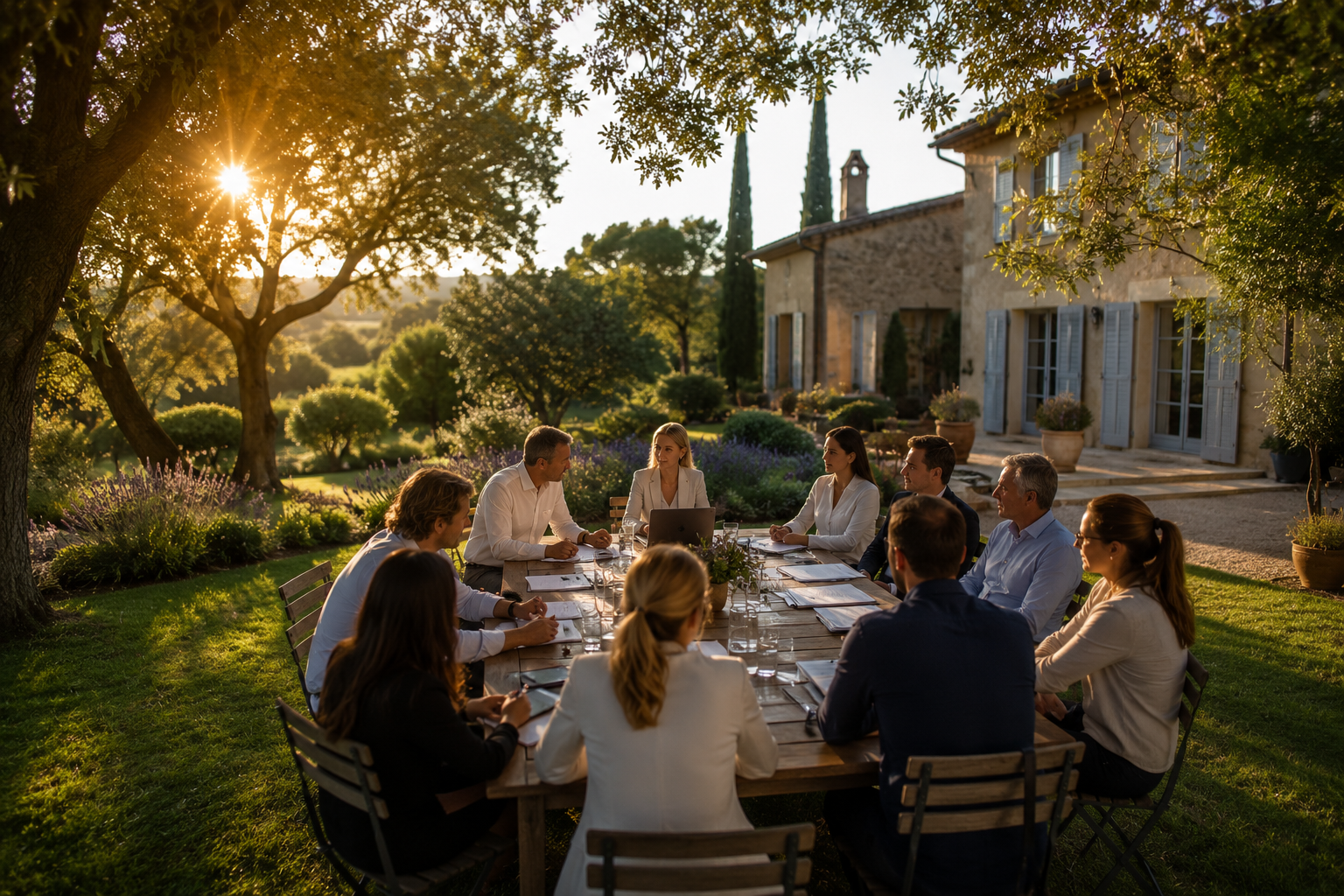
It is the first question every company asks and the last one most agencies answer. The honest reply is that a retreat has no single price, because two groups of the same size on the same dates can sit thousands of euros apart depending on decisions that look minor when you make them. What follows is how the budget is actually built, what moves it, and the four lines that companies routinely leave out until the quote arrives.
First proposal within 48 hours.
Why there is no single price
A retreat is not a room rate, so it cannot be quoted like one. The figure that matters is the cost per participant for a complete programme: accommodation, meals, the working sessions, the experiences around them, transport on the ground and coordination throughout. Two groups of the same size, on the same dates, in the same region, can sit a long way apart on that figure. What follows is what separates them, so you can read your own budget before anyone quotes you.
Accommodation is the pivot, and it is not linear
The single largest line, and the one that decides most of the rest. It is not a smooth scale, it steps.
The first step is single versus shared rooms. Advertised capacity almost always assumes double occupancy, so a property listed for thirty guests may only hold sixteen or eighteen in single rooms. For a leadership group where nobody shares, the same property suddenly costs far more per head than the brochure suggests.
The second step is exclusivity. Taking a property over entirely means paying for every room whether or not you fill it. That is often the right call, because a private estate with strangers at breakfast is not a private estate. But it means your cost per person falls sharply with each additional participant, which is why headcount and venue have to be decided together rather than in sequence.
The catering line depends on the venue, not on your taste
This is the most underestimated relationship in a retreat budget. A hotel has a kitchen, a brigade and a service team already in place, so meals are a per-head cost. A private estate usually has none of that. Bringing in a chef means bringing in their equipment, their preparation space, their cold storage and their service team, and that cost barely moves whether you are twelve or twenty.
The practical consequence is counterintuitive. On a small group, an estate with a private chef can cost more per person than a very good hotel. On a larger group, it inverts. There is no general answer, only a calculation to run once the headcount is known.
Transport is a function of geography, not of comfort
Every kilometre between the venue and the activities turns into vehicles, drivers and waiting time. A property forty minutes from everything is not slightly less convenient than one fifteen minutes away, it is a different transport plan.
Two things move this line more than people expect. The first is the arrival airport, because a transfer of two and a half hours for the whole group, in both directions, is a different order of cost from a transfer of forty minutes. The second is the road itself: some of the most beautiful properties in the Luberon and the Alpilles sit at the end of lanes a full size coach cannot use, which forces you into several smaller vehicles for the entire stay.
Season changes the price of the same programme
The identical programme, at the identical venue, does not cost the same in June and in November.
July and August are the most expensive and the least suited to a working retreat: heat, crowds, and properties booked long in advance by private clients. September is the month everyone asks for and the hardest to secure, because the finest estates are taken by weddings almost every weekend. Mid October and the second half of November are where the best properties become available on the best terms, with mild days and terraces still in use. January and February suit shorter urban formats, when the point is to work rather than to be outdoors.
Moving a retreat by three weeks is often the cheapest saving available, and the only one that costs nothing in quality.
The four lines companies forget
Not because they are hidden, but because they sit outside the obvious list.
Drinks. A quoted meal price rarely includes wine, and on a three day programme the difference between water on the table and wine at every dinner is a real line, not a rounding error.
The people who are not participants. A facilitator, a photographer, a speaker or a chef staying on site all need a room and a seat at the table. On a small group, two extra people can shift the per-head figure noticeably.
The weather plan. A programme built entirely outdoors needs an indoor alternative that holds the whole group seated. If the venue does not have one, you are paying for a second space you hope never to use.
Cancellation exposure. Deposits are typically staged well before the stay, and the terms your supplier imposes are the terms you inherit. This is not a cost until it is one, and it is the line worth reading before signing anything.
Where the real savings are
Three levers work. The rest tends to damage the programme without saving much.
Change the date. As above, this is the largest saving that costs nothing.
Change the arrival airport. On a group of twenty, the difference between a forty minute transfer and a two and a half hour transfer, in both directions, funds a great deal of programme.
Fill the rooms you are already paying for. If the venue is taken over entirely, each additional participant costs only their meals, their activities and their seat in the vehicle. The accommodation is already bought.
What does not work is trimming the experiences. They are rarely the largest line and they are always what people remember.
How we quote
We build a single all-inclusive price, with our margin inside it, rather than charging separate design fees on top. You are paying for a fully coordinated programme: the design, the sourcing and negotiation with every supplier, the logistics, and our presence on the ground. The venue side is set out on our page on corporate retreat venues in Provence, the programme side on corporate retreats in Provence, the shorter formats on company offsites, and the leadership formats on executive retreats in France. For larger headcounts, see group travel in Provence, and if you are placing a client with us rather than travelling yourself, our trade partners page sets out how that works. Send dates and a rough headcount through our contact page and we come back with a costed outline within 48 hours.
First proposal within 48 hours.
Frequently asked questions
What determines the cost of a corporate retreat in Provence?
Four things, in order of weight. Whether rooms are single or shared, because advertised capacity almost always assumes double occupancy. Whether the venue is taken over entirely, since exclusivity means paying for every room whether or not you fill it. The standard of the tables and whether catering is brought in or already in place. And the season, which moves the price of an identical programme at an identical venue.
What is the most expensive part of a corporate retreat?
Accommodation, in almost every case, and it does not scale smoothly. Single occupancy rather than shared rooms can nearly double the accommodation line for the same property, and taking a venue over entirely means paying for every room whether or not you fill it. Catering comes second, and its cost depends more on the venue than on the menu.
Is it cheaper to hold a retreat in a hotel or a private estate?
It depends on the group size. A hotel already has a kitchen and a service team, so meals are a per-head cost. A private estate requires a chef, equipment and a service team to be brought in, and that cost barely changes between twelve and twenty people. Small groups often come out cheaper in a hotel, larger groups in an estate.
When is the cheapest time of year for a corporate retreat in Provence?
Mid October and the second half of November, which are also two of the best windows in terms of quality: the finest properties are available on favourable terms, and the days are still mild. July and August are the most expensive and the least suited to a working programme. Moving a retreat by three weeks is usually the largest saving available.