Private tour Marseille: discover the city as only locals know it
Aura Provence offers premium private guided tours of Marseille for travel agencies, incentive groups and private clients. Our tours go far beyond the standard sightseeing circuit to reveal the authentic, layered, intensely Mediterranean city that most visitors never access.
Marseille through insider eyes
Marseille is the oldest city in France — founded in 600 BC by Phocaean Greek sailors who, according to legend, arrived to find a local princess choosing her husband by offering a cup of wine at a banquet. She gave it to the Greek captain Protis. Marseille was born from that encounter.
Over 2,600 years, the city has absorbed wave after wave of Mediterranean influence: Phoenician, Roman, Genoese, Spanish, North African, Italian, Corsican and Levantine. The result is a city unlike any other in France — more dense, more surprising, more alive, and more resistant to the tourist gaze.
This is a city that does not perform itself for visitors. It rewards attention, patience and a knowledgeable local guide. Our team of Marseille-born guides — historians, architects, journalists and former chefs — open doors that no guidebook can reach: a working artist's studio in the Panier, a private apartment overlooking the Vieux-Port, a fishmonger who has supplied the same family of restaurants for four generations, a Corsican grocer whose shop has not changed since 1962.
What a private tour of Marseille includes
Our private Marseille tours are designed around your group's specific interests and pace. Possible elements include: the historic Panier neighbourhood with its Byzantine-inspired Major Cathedral and artists' studios; the Corniche and its panoramic views of the Frioul archipelago; the Vallon des Auffes, a hidden fishing hamlet tucked into the city's coastal road; Notre-Dame de la Garde, the basilica known to every Marseillais as "La Bonne Mère"; and, for culturally curious groups, a contemporary reading of the city's architecture, street art and civic identity by our local expert guides.
For gastronomic groups, we design tours built around the city's culinary identity: a sunrise visit to the fish market on the Quai des Belges, a private bouillabaisse lunch at one of the three restaurants still authorised by the official Charter, a navette tasting at the Four des Navettes (in continuous operation since 1781), and a pastis tasting flight comparing the great Marseille distilleries.
For art and architecture lovers, we open the doors of the MUCEM (the Museum of European and Mediterranean Civilisations, designed by Rudy Ricciotti), arrange private guided readings of Le Corbusier's Cité Radieuse, and curate visits to the Friche Belle de Mai — a former tobacco factory turned cultural complex that is one of the most active contemporary art venues in southern Europe.
The Calanques: Marseille's National Park
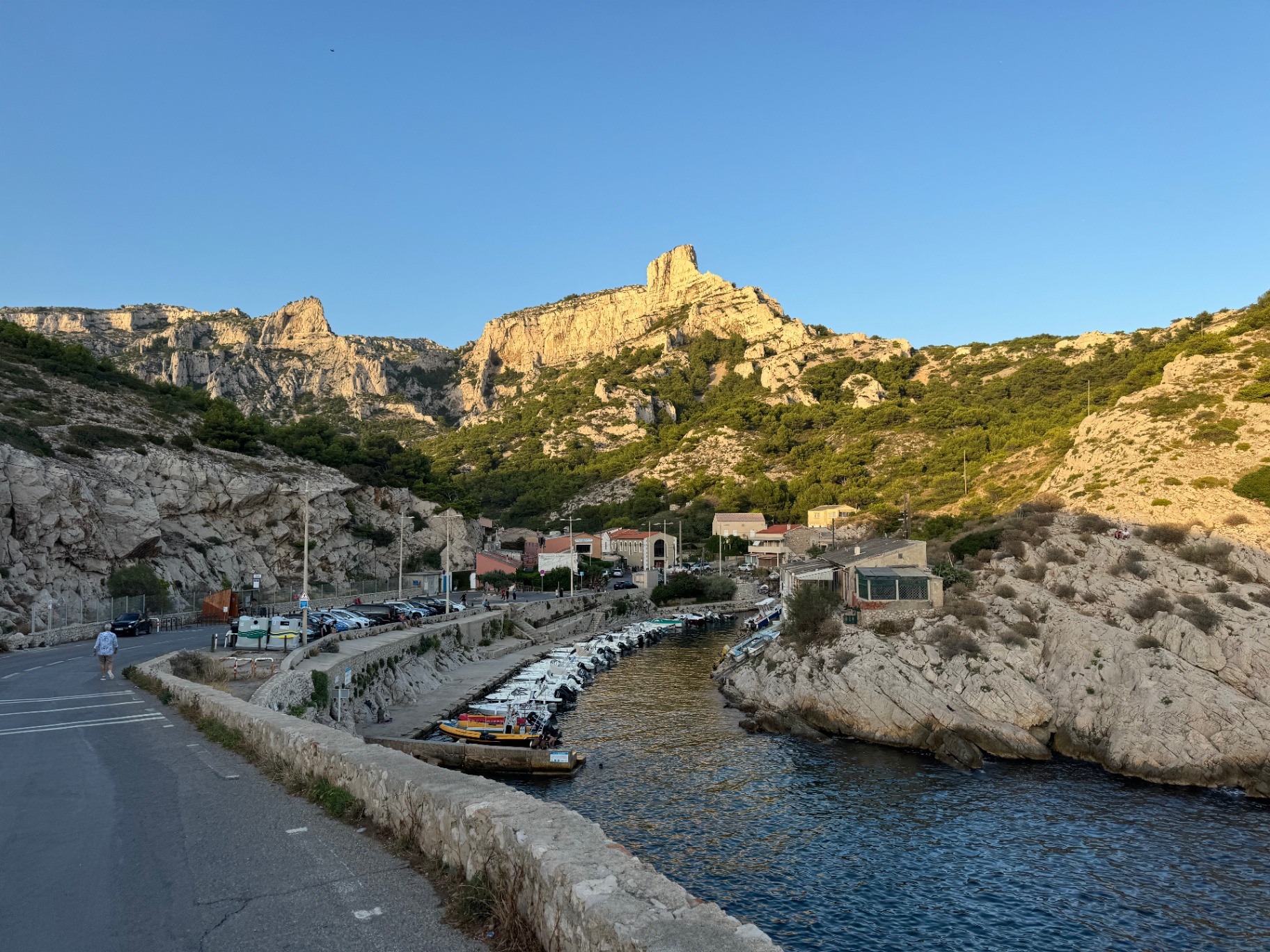
No private tour of Marseille is complete without the Calanques National Park — the only urban national park in France and one of the most spectacular natural landscapes in the Mediterranean. We organise private boat excursions, guided coastal walks and exclusive picnic experiences among the white limestone cliffs and emerald-blue water of this extraordinary protected area.
The Calanques are not a backdrop — they are a working part of Marseille life. Our boat captains know which inlets fill and empty by the hour, where the light is most cinematic at 6pm in late June, and which discreet swimming spots remain accessible even on the busiest summer weekends. For groups, we can arrange exclusive-use catamarans with onboard chef, paddleboard and snorkelling equipment, and a route designed to combine swimming, photography and coastal commentary.
Coming in on a cruise call
A cruise call in Marseille is a different exercise from a resident stay. Vehicles cannot wait inside the terminal perimeter, so the meeting point sits outside it — a walk of roughly fifteen minutes from the gangway, along a stretch of working port that is unremarkable but straightforward. We would rather name that walk in advance than have it discovered on the morning, because it is the one part of the day nobody can compress.
Everything else is built backwards from the return to the ship. That deadline, not the list of things worth seeing, is what shapes the day: we hold a comfortable margin against it, and we protect that margin rather than the itinerary. If the port is busy or a group moves more slowly than expected, the programme gives way first. Guests who spend the last hour watching the clock have not had a good day out, whatever they saw.
The compensation is that distances here are short. The Vieux-Port, the Panier, the Corniche and the museum quarter all sit within a few minutes of the quays, which means a half day can be genuinely dense without ever drifting far from the ship. Groups who want the Calanques or the countryside are better served on a full call with an early start; for a standard call, staying close to the port is not a limitation but the reason the day works. For operators placing whole groups on a single call, our page on how we operate shore excursions for cruise groups sets out the ground logistics in detail.
Multi-day Marseille programmes
For travel agencies and high-end groups spending three or more nights in Marseille, we design integrated programmes combining city exploration with day trips to Cassis and the wine country, Aix-en-Provence, the Camargue, the Luberon, and the Sainte-Baume sacred forest. Marseille is the natural base for almost every meaningful experience in Provence — a fact that surprises many first-time visitors but quickly becomes obvious.
Direct flights from London, Paris, Geneva, Brussels, Frankfurt, Madrid, Amsterdam, New York and Montréal land at Marseille-Provence airport, twenty-five minutes from the city centre. For incentive and corporate groups, this accessibility is one of the city's quiet strategic advantages.
Frequently asked questions
How long does a private tour of Marseille last?
We offer half-day tours (4 hours), full-day tours (7-8 hours) and multi-day Marseille programmes for groups staying in the city. All formats are fully customisable to your group's interests, pace and physical condition.
Do your guides speak English?
Yes. All of our Marseille guides are fluent English speakers. We also work with guides in French, German, Italian and Spanish upon request.
What is the best season for a private tour of Marseille?
Marseille is one of the rare French cities that is genuinely pleasant year-round. April to June and September to early November are the optimal months: warm light, manageable crowds, every restaurant terrace open. July and August are hotter and more crowded, but the long evenings and Mediterranean atmosphere are exceptional. Winter (December to March) is mild, quiet and surprisingly luminous.
How many participants can join a private tour?
Our private tours are designed for groups from 2 to 50 participants. Beyond 15 people we typically split into parallel groups, each with its own guide, to preserve the intimacy of the experience and access to smaller venues.
Can the tour be combined with a yacht or boat experience?
Absolutely. We frequently combine a morning city tour with an afternoon private boat charter into the Calanques National Park, departing directly from the Vieux-Port. We can also arrange day cruises to the Frioul archipelago or the Côte Bleue.
Do you handle hotel accommodation as part of the tour?
Yes. As a fully licensed DMC (Atout France IM013250009), we coordinate the entire stay: 5-star hotels, restaurants, transfers, security if required, and exclusive cultural access. Our preferred Marseille addresses include the InterContinental Hôtel-Dieu, the Sofitel Vieux-Port, and a curated selection of private villas on the Corniche.
Is Marseille safe for tourists?
Yes. The neighbourhoods that interest international visitors — the Vieux-Port, the Panier, the Corniche, the area around the MUCEM and the Cours Julien — are safe, busy and well-policed throughout the day and well into the evening. As in any major European port city (Naples, Barcelona, Lisbon), normal vigilance with personal belongings is recommended. Our private programmes include vetted drivers, 5-star accommodation and 24/7 concierge support throughout the stay.
How do I get from Paris to Marseille?
The fastest option is the TGV high-speed train from Paris-Gare de Lyon, reaching Marseille-Saint-Charles in 3h15 with frequent direct services. Flights from Paris-Orly and Paris-CDG land at Marseille-Provence airport in 1h25, twenty-five minutes from the city centre. We coordinate the full door-to-door transfer in chauffeured Mercedes V-Class or executive sedans.
Is Marseille a better base than Nice for exploring Provence?
Yes — for Provence specifically. Marseille sits at the geographic heart of the region: the Calanques begin at the city limits; Cassis is 30 minutes away; Aix-en-Provence is 30 minutes; the Luberon is 1h00; the Camargue is 1h15. Nice is wonderful for the Côte d'Azur (Saint-Tropez, Monaco, Èze) but adds at least 2h00 to any Provençal itinerary. For groups whose focus is Provence, Marseille is the natural base.
What is the must-eat dish in Marseille?
Bouillabaisse — the legendary Mediterranean fish stew, prepared to the strict 1980 Marseille Charter with rascasse, congre, Saint-Pierre and rouget, served with rouille, croutons and Gruyère. Only a handful of restaurants are authorised to serve the authentic version. We hold private tables at the most respected addresses. The other Marseille specialities are pieds-paquets (slow-cooked lamb tripe), panisse (chickpea fritters) and the navette biscuit from the 18th-century Four des Navettes.