How to choose a DMC in Provence: a practical guide
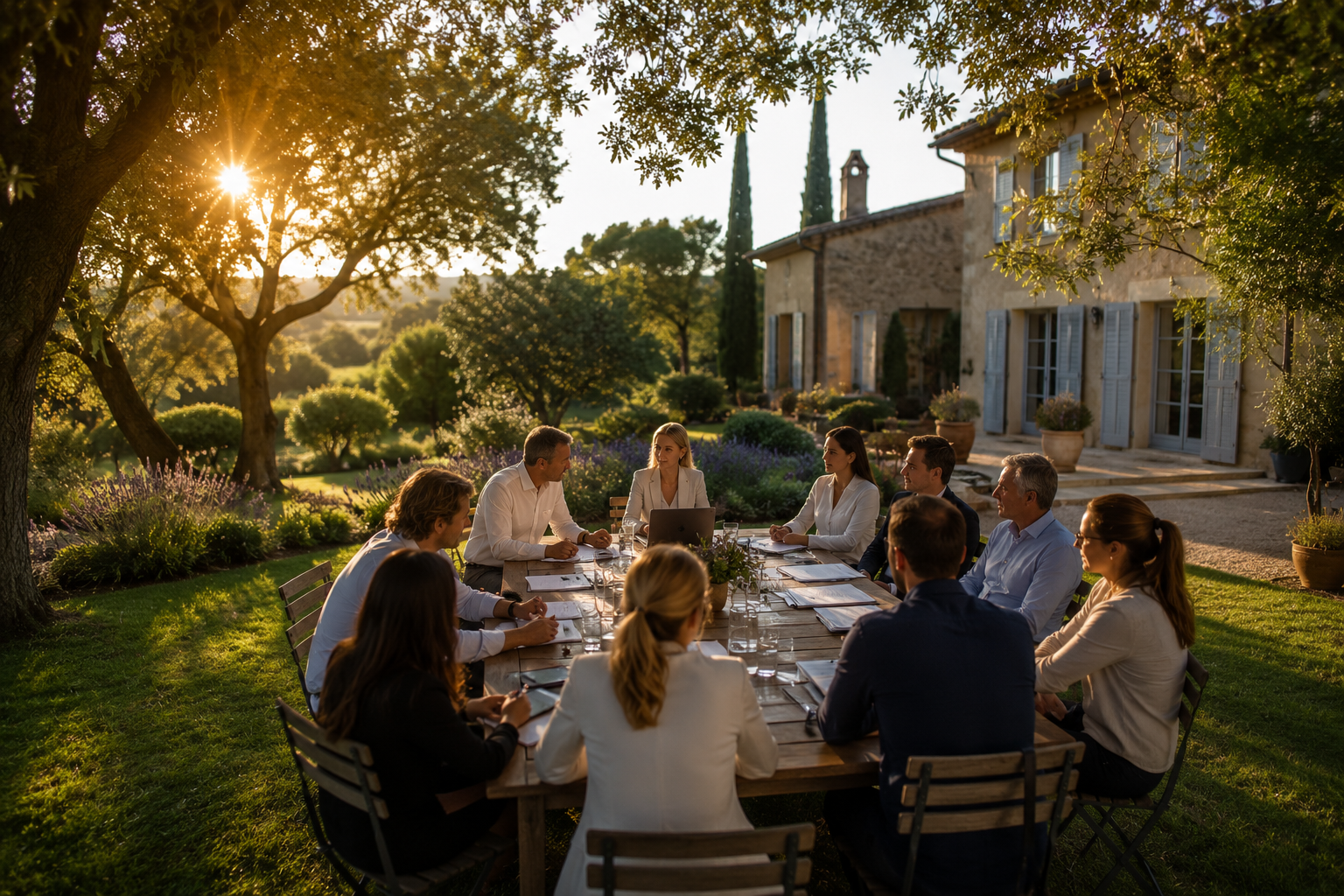
Choosing a destination management company is a quiet decision with loud consequences. The right partner disappears into the background of a beautifully run trip; the wrong one turns up in every complaint on the debrief call. This guide is written for travel advisors, agencies, tour operators and corporate planners who need to compare providers in Provence without wading through marketing brochures. It is deliberately generic on the numbers and specific on the questions worth asking.
First proposal within 48 hours.
What a DMC actually does
A DMC in Provence has two jobs that must sit in the same pair of hands: design and on the ground operation. Design means shaping an itinerary that fits the client, the season and the region, choosing the right villages, the right tables and the right pace. Operation means running that itinerary on the day, coordinating transfers, briefing drivers and guides, holding a supplier network built over years and being reachable when a mistral cancels a boat or a chef offers a last minute kitchen visit. A DMC is your single point of contact for everything that happens between arrival and departure.
This is different from a tour operator, which packages and resells trips at scale, and different from a concierge, which reacts to individual requests inside an existing stay. A DMC owns the programme end to end and stands behind it in person. For the full service view, see our page on our work as a local DMC in Provence.
When you need one, and when you do not
A DMC earns its place when the trip has moving parts. Groups, corporate retreats, incentives, multi day private itineraries, and any programme where an agency places clients remotely and needs a reliable local operator all fall clearly inside DMC territory. So does anything that combines several suppliers, several venues or several days in a row, because that is where coordination stops being optional. For clients placed by agencies from abroad, see our trade partners page, and for groups specifically, see our page on group travel in Provence, which covers formats from two to fifty people.
A DMC is overkill for a single hotel booking, a one off restaurant reservation or a transfer with no wider itinerary around it. Those requests are better handled directly with the supplier or with a concierge. Asking a DMC to book a table for two is possible, but the value of the partnership only appears once the brief is a full programme.
How pricing models work
In generic market terms, DMCs quote in one of three ways. The first is net rates, where the DMC gives the agency a clean cost and the agency adds its own margin before quoting the end client. This model is common with independent luxury agencies that want full control over how the trip is sold. The second is commissionable rates, where the DMC quotes a selling price and pays back a commission on confirmation. The third is package pricing, where the DMC delivers a single all inclusive quote per programme, transparent by line, without the agency needing to reconstruct the underlying costs.
Whatever the model, a few things should always be included in the quote and never billed as extras once the trip has started: transfers coordination between suppliers, on call presence for the duration of the stay, and active supplier management before, during and after the programme. If any of those three sit outside the quote, the price is not really the price.
The questions to ask before signing
A short list of questions filters most of the market quickly. Do you operate yourself, or do you subcontract everything to a third party? Are you licensed and bonded to sell travel services in France, with an Atout France registration number and a financial guarantee you can name on the spot? Who will physically be present on the ground on the day of the programme, and can I have their name and role in the final dossier? How fast do you return a first quote after a full brief, and what is your standard response time during the trip itself? Do you know the venues you propose personally, or are you selecting them from a database?
None of these questions is confrontational. All of them are answered easily by a serious DMC, and all of them reveal a lot about a less serious one.
Red flags
A few signals should slow the conversation down. No local base in the region the DMC claims to cover, or a head office two flights away with nothing on the ground. Stock itineraries that arrive within minutes of the first brief and look identical for every client. No licence number displayed anywhere on the website or in the contract. Reluctance to name, before departure, the person who will actually be present on the day. Prices that move up sharply after signing, with fees appearing for coordination or support that should have been included from the start. None of these are proof of bad faith on their own; together, they are a pattern.
Why being Marseille based matters for Provence
Provence rewards proximity. The region stretches from the calanques of Cassis and Marseille in the south to the lavender plateaus of the Luberon and the Alpilles inland, with the Camargue to the west and the Sainte Baume massif in between. A DMC based in Marseille reaches almost every point of interest within an hour or two, which changes the quality of the supplier relationships and the speed of reaction when something needs to move on the day. Being local also means being present at the venues we recommend, not once a year on an inspection trip but through the season, so that our knowledge of a chef, a winemaker or a boat captain reflects how they are working this month rather than last year. For our position specifically on the city, see our page on DMC in Marseille.
Moving forward
The fastest way to test any DMC is to send a real brief and read the reply. A short call or a detailed email is enough to see the design instinct, the response time and the way the partner handles what it does not yet know. If you would like to run that test with us, please write through our contact page, and we come back within 48 hours.
First proposal within 48 hours.
Frequently asked questions
What is the difference between a DMC and a travel agency?
A travel agency sells trips to end clients. A DMC, or destination management company, is the local partner that designs and operates those trips on the ground in a specific region. The agency owns the client relationship; the DMC owns the local execution, the supplier network and the presence on the day.
Does a DMC only make sense for large parties?
No. The value is in the design, the vetted suppliers and the single point of contact, not in the headcount. A multi day itinerary for four or six travellers benefits from the same coordination as a fifty person programme. What changes is the scale of the logistics, not the method.
How far in advance should you engage a DMC in Provence?
For peak months in Provence, roughly May, June and September, four to six months ahead is a comfortable window. For shoulder and winter dates, six to eight weeks is usually enough. Serious DMCs will still take a late brief and will tell you honestly what remains achievable.
Do DMCs work with foreign travel advisors?
Yes. Most established DMCs work primarily with foreign travel advisors, agencies and tour operators who place their clients remotely. Look for a partner that offers clear net rates, a dedicated designer per programme and a fast response time regardless of your time zone.